
Machine learning (ML) has moved from research labs to real-world products powering everything from recommendation engines and fraud detection to self-driving cars and predictive maintenance.
But deploying a machine learning model in production is not as simple as training one in a Jupyter notebook.
That's where MLOps comes in a framework that applies the principles of DevOps to machine learning systems, bridging the gap between data science and engineering to deliver reliable, reproducible, and scalable AI systems.
This guide will walk you through what MLOps is, why it matters, and how to implement it step by step from data preparation to deployment and monitoring.
What Is MLOps?
MLOps (Machine Learning Operations) is the discipline of managing the end-to-end lifecycle of machine learning models from development to deployment and ongoing monitoring.
If DevOps focuses on continuous integration and delivery (CI/CD) for code, MLOps extends those principles to models, data, and experiments.
The Goal of MLOps
To build a system where:
- Data scientists can iterate on models quickly.
- Engineers can deploy models seamlessly to production.
- Operations teams can monitor and maintain performance at scale.
In short, MLOps helps turn "models that work on your laptop" into "models that work reliably in production."
Why MLOps Is Necessary
A common misconception in AI projects is that success ends with training a high-accuracy model. In reality, that's only about 20% of the work. The real challenges begin after the model is deployed.
Common Pain Points Without MLOps
| Challenge | Description | Impact |
|---|---|---|
| Model Drift | Data distribution changes over time | Predictions degrade silently |
| Environment Mismatch | Local vs. production environments differ | Model breaks during deployment |
| Manual Deployment | Ad hoc scripts and manual updates | High risk of error |
| Lack of Version Control | No tracking of datasets, models, or experiments | Impossible to reproduce results |
| Slow Collaboration | Data scientists, engineers, and ops teams siloed | Longer delivery cycles |
The Machine Learning Lifecycle End to End
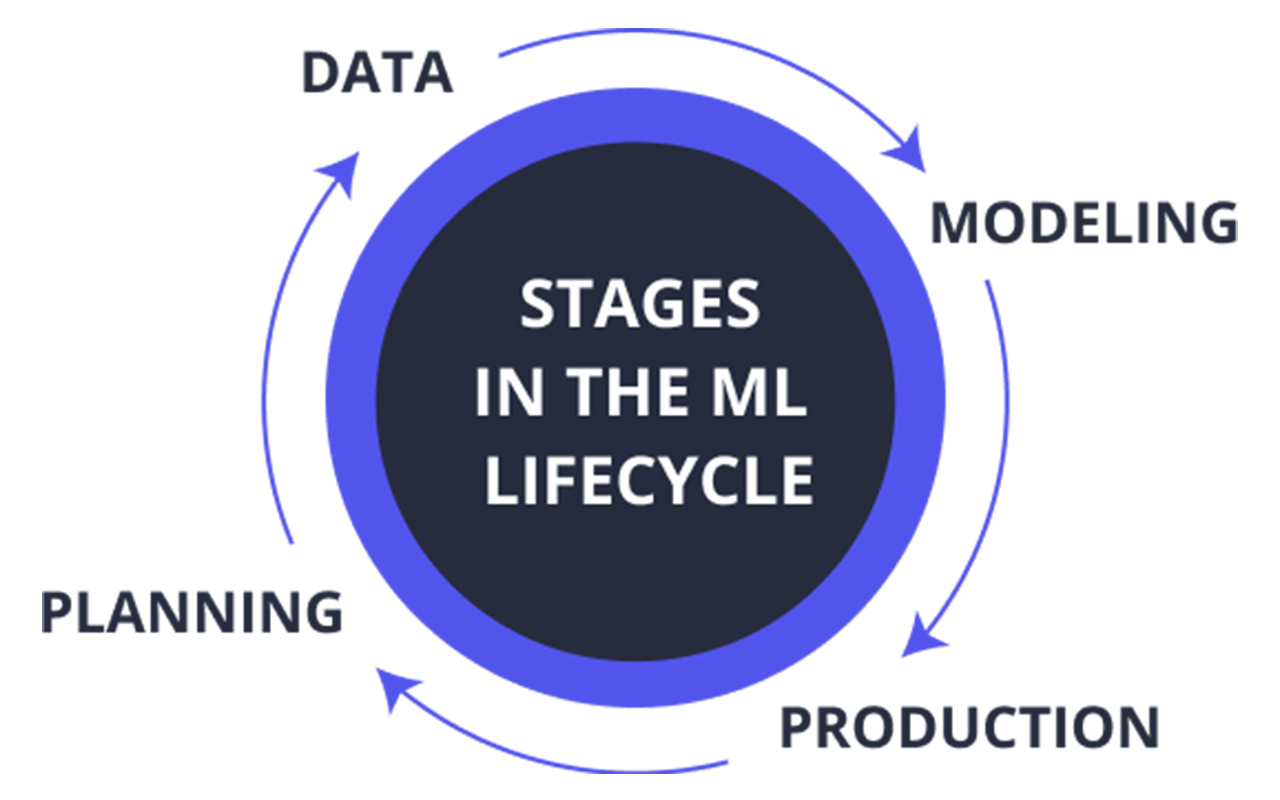
Before we dive into tooling, let's visualize the ML lifecycle that MLOps manages:
Data Collection → Data Preparation → Model Training → Model Validation → Deployment → Monitoring → Feedback Loop
1. Data Collection & Preparation
- Ingesting raw data from multiple sources (APIs, databases, sensors)
- Cleaning, labeling, and transforming data for training
- Versioning datasets to ensure reproducibility
- Tools: Apache Airflow, Great Expectations, DVC (Data Version Control), Delta Lake
2. Model Training & Experimentation
- Building and testing different model architectures
- Hyperparameter tuning and cross-validation
- Logging experiments and results
- Tools: MLflow, Weights & Biases, TensorBoard, Optuna
3. Model Validation
- Evaluating performance on unseen test sets
- Checking bias, fairness, and robustness
- Comparing performance across versions
- Tools: Scikit-learn, Evidently AI, Deepchecks
4. Model Deployment
- Packaging the trained model (as Docker image or serialized file)
- Deploying to cloud, edge, or on-prem environments
- Supporting real-time or batch inference
- Tools: AWS SageMaker, Azure ML, Kubeflow, TensorFlow Serving, BentoML
5. Monitoring & Maintenance
- Tracking performance drift, data quality, and latency
- Alerting when models degrade or inputs change
- Automating retraining or rollback
- Tools: Prometheus, Grafana, WhyLabs, Arize AI, MLflow Monitoring
The Pillars of MLOps
To operationalize ML effectively, you need to think in terms of three main pillars: automation, collaboration, and governance.
Automation: From Manual to Continuous ML
In MLOps, automation enables Continuous Integration, Continuous Deployment, and Continuous Training (CI/CD/CT).
- 🔁 Continuous Integration (CI): Automate model testing and validation with each new dataset or code change.
- 🚀 Continuous Deployment (CD): Automatically package and deploy models to production once validated.
- 🧠 Continuous Training (CT): Periodically retrain models when data drifts or performance drops.
Collaboration: Bridging Data Science and Engineering
- Shared Infrastructure: Data scientists and engineers operate on the same cloud or containerized environments.
- Shared Metadata: Models, datasets, and experiments are tracked in central repositories.
- Shared Culture: Ops teams monitor pipelines, while data scientists focus on improving models.
Governance: Trust, Compliance, and Reproducibility
MLOps enables governance through dataset and model lineage tracking, versioned metadata for audits, and bias/fairness checks.
Building Your MLOps Pipeline: A Step-by-Step Framework
Step 1: Data Versioning and Validation
Store and version all raw and processed data. Recommended Tools: DVC, Great Expectations.
Step 2: Automate Training Pipelines
Orchestrate your ML workflow using a pipeline engine. Recommended Tools: Apache Airflow, Kubeflow Pipelines, MLflow.
Step 3: Containerize and Deploy Models
Package your trained model into a container for easy deployment. Recommended Tools: Docker, Kubernetes, BentoML, SageMaker.
Step 4: Set Up CI/CD Pipelines
Automate integration and deployment of new models. Recommended Tools: GitHub Actions, GitLab CI, Terraform.
Step 5: Implement Monitoring and Feedback Loops
Measure real-world performance and detect drift. Recommended Tools: Prometheus, Grafana, WhyLabs, Arize AI.
The MLOps Tech Stack 2025 Edition
| Stage | Tools | Purpose |
|---|---|---|
| Data Management | DVC, Delta Lake, Feast | Versioning and feature store |
| Pipeline Orchestration | Airflow, Kubeflow, Prefect | Automate ML workflows |
| Experiment Tracking | MLflow, Weights & Biases | Manage experiments and results |
| Model Deployment | BentoML, TF Serving, Seldon | Serve models in production |
| Monitoring & Logging | Prometheus, Arize, WhyLabs | Track model drift and uptime |
| Infrastructure | Docker, Kubernetes, Terraform | Containerization and IaC |
MLOps in the Cloud: AWS, Azure, and GCP
Cloud platforms now offer native MLOps solutions that abstract much of the complexity.
- 🟡 AWS SageMaker: Built-in model registry, pipeline automation, and deployment.
- 🔵 Azure Machine Learning: Drag-and-drop pipeline builder and Responsible AI toolkit.
- 🔴 Google Vertex AI: Unified environment for training, deployment, and monitoring.
Case Study: MLOps in Action
🎯 Problem: A retail company's recommendation model degraded over time due to changing product data. Manual retraining caused downtime.
🧩 Solution: Adopted MLOps using Airflow, MLflow, and Kubernetes.
🚀 Results: Retraining time reduced from 3 days to 3 hours; 25% increase in accuracy.
Best Practices for Successful MLOps Adoption
- Start Small: Automate one stage before the entire lifecycle.
- Embrace Version Control: Treat data and models like code.
- Monitor Everything: Data drift, latency, and bias all matter.
- Integrate Early with DevOps: Align processes with existing pipelines.
- Design for Scalability: Use containerization and cloud-native services.
The Future of MLOps
Emerging trends include AutoMLOps, Edge MLOps for IoT, and LLMOps specifically for large language models. As AI systems become more complex, MLOps will be the foundation ensuring their reliability and safety.
Conclusion: Turning ML Chaos into ML Confidence
Building machine learning models is hard but maintaining them in production is even harder. MLOps transforms that chaos into confidence by creating a structured, automated, and auditable process for managing the ML lifecycle.